


If you’ve ever seen a “stainless” handrail or balustrade near the beach go brown and patchy, you’ve seen what salt air and chlorinated water can do. The same thing can happen to stainless sculpture if the wrong grade or finish is used – especially around Australian coastal homes, hotel pools and exposed rooftops.
This article is about de-risking that investment: choosing 316 stainless, pairing it with the right finish, placing it intelligently, and giving it a simple care plan so it stays beautiful for decades.




Why stainless behaves differently near the sea and pool
Coastal and poolside environments are hard on metals:
- Salt-laden air carries chlorides that settle on surfaces and draw in moisture.
- Wind-borne spray from surf or infinity pools creates “splash zones” where water regularly dries on the metal.
- Chlorinated pool water can accelerate localised corrosion if it’s allowed to sit in crevices or on rough surfaces.
The visible result is often:
- Tea staining – brown streaks or patches on the surface.
- Pitting – tiny, often irreversible pinholes in the steel.
Clients often assume this is “bad stainless” or “poor polishing”. In reality, it’s almost always a combination of:
- The wrong grade (304 instead of 316 in a marine environment).
- The wrong finish (rough brushed surface that holds contaminants).
- Poor detailing and placement (water traps, splash zones, glare not considered).
- No cleaning plan at all.
Placement & detailing: designing for water, wind and sun
Even the best material and finish can be undermined by poor detailing. When we design and site stainless steel sculpture near the sea or a pool, we look closely at how water, wind and sun move around it.
Splash and overspray zones
We’ll talk with you about:
- Distance from the pool edge or surf – closer pieces may need electropolish and more frequent rinsing.
- Prevailing wind direction – which side of the piece will get the most salt or chlorinated spray?
- Whether we can angle surfaces so water sheds quickly instead of pooling.
Avoiding water traps
Good detailing can dramatically reduce corrosion risk:
- Designing drip edges so water naturally falls away from key surfaces.
- Avoiding horizontal ledges where puddles form.
- Ensuring fixings are enclosed or drained, so moisture doesn’t sit in hidden cavities.
Hidden fixings & clean lines
We typically use hidden fixings and engineered bases that:
- Keep the visual focus on the artwork.
- Reduce crevices where water and grime can accumulate.
- Make it easier to rinse and clean around the base.
Glare and sightlines
Stainless can be wonderfully reflective – or uncomfortably bright.
For mirror-polished coastal and poolside sculptures, we’ll consider:
- The sun path across the day.
- Nearby glass (windows, balustrades) that could catch reflections.
- Seating positions so guests aren’t looking into a bright reflection at midday.
Glare tip: Where possible, place the sculpture so the main reflective surfaces are angled slightly away from primary seating and window sightlines during the middle of the day.
304 vs 316 – what actually changes?
Both 304 and 316 are austenitic stainless steels, but there’s one key difference:
- 316 stainless contains molybdenum, which significantly improves resistance to chlorides (salts).
- This is why 316 is often called “marine grade” stainless.
In practice:
- Use 316 when:
- The sculpture is near the ocean (coastal suburbs, clifftop homes, seaside hotels, marinas).
- The work is within splash or overspray range of a chlorinated or saltwater pool.
- It’s on a rooftop or balcony regularly exposed to sea breeze.
- 304 can be acceptable when:
- The site is well inland, with low salt exposure.
- The piece is sheltered (e.g. under cover, not in a splash zone).
- There are clear budget constraints, and we can control finish, detailing and maintenance.
At Sculptura, our default recommendation for coastal and poolside pieces is 316, with a finish and placement plan that supports it.


The finish: mirror, satin, electropolish – and why it matters
The smoother the surface, the less it holds onto contaminants. That’s the core principle.
Mirror polish
- What it is: Highly polished, almost reflective finish.
- Benefits:
- Very smooth surface, so salt and grime have little to cling to.
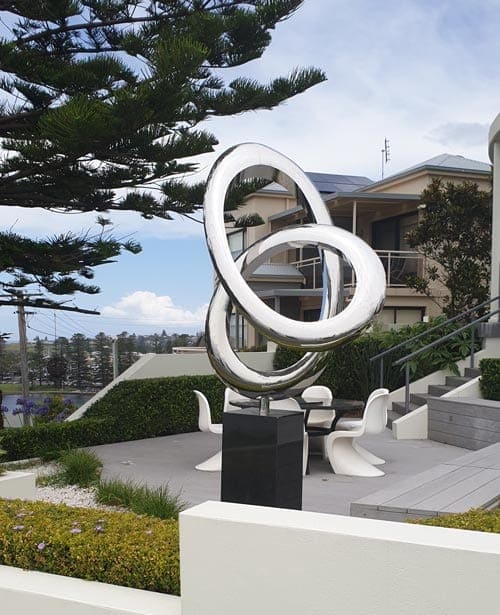
- Visually striking, especially near water where it can echo the pool or ocean.
- Considerations:
- Shows fingerprints and minor marks more easily in low-traffic areas (less of an issue for large outdoor works).
- Can produce glare if placed in direct sun, especially near glass and seating areas.
Satin / brushed finish
- What it is: Soft sheen with visible grain from brushing.
- Benefits:
- Hides minor scuffs and handling marks.
- Can feel warmer and more understated than mirror.
- Considerations:
- The micro-grooves can trap salts and contaminants, which increases tea staining risk in severe marine or poolside locations.
- Needs more frequent rinsing in coastal exposure compared with mirror or electropolish.
Electropolish
- What it is: An electrochemical treatment that removes a microscopic layer of steel, smoothing and “leveling” the surface beyond what mechanical polishing alone can do.
- Benefits:
- Outstanding corrosion resistance, especially in harsh coastal sites and pool splash zones.
- Makes the surface easier to clean; contaminants have less to bond to.
- When we recommend it:
- Sculptures within several metres of surf or the high-tide line.
- Pool edges, water features, and overspray zones.
- Exposed rooftop terraces with direct sea breeze.
For the harshest sites, we often specify 316 stainless + electropolish, sometimes over a mirror-polished base, to combine visual drama with maximum durability.
FAQs: Stainless steel sculpture near the sea and pool
Is 304 ever OK outdoors?
Yes. 304 stainless can perform very well in inland or sheltered outdoor locations with low salt exposure and a sensible cleaning schedule. For coastal homes or poolside pieces, we strongly prefer 316 because of its superior resistance to chlorides.
Mirror vs electropolish: which resists tea staining better?
Both can perform very well, but electropolish usually offers the best resistance in severe marine or pool environments because it further smooths the surface at a microscopic level. For many homes, a high-quality mirror polish on 316 plus regular rinsing is more than sufficient.
How often should I rinse a seaside piece?
As a rule of thumb, weekly or fortnightly for pieces close to the ocean. If you can see or taste salt on outdoor furniture or glass, the sculpture is experiencing the same environment and should be rinsed regularly.
Will chlorine damage stainless?
Occasional splash from a chlorinated pool that is rinsed off is not a problem. Issues arise when chlorinated water is allowed to dry repeatedly on the surface or sit in crevices. That’s why we focus on good detailing and recommend regular fresh-water rinsing for poolside pieces.
Can you retrofit a different finish later?
In many cases, yes. A stainless sculpture can often be re-polished or electropolished later, depending on its design and condition. It’s usually more cost-effective to choose the right grade and finish at the start, but for existing pieces we can assess and recommend options.
A simple care schedule that owners will actually follow
Stainless sculpture doesn’t need fussy maintenance. It does need occasional, intentional cleaning, much like a car.
Rinse frequency (rule of thumb)
- Seaside (within a few hundred metres of the ocean):
- Weekly or fortnightly fresh-water rinse.
- Coastal suburbs and poolside settings:
- Fortnightly to monthly rinse, depending on exposure.
- Inland, low-salt environments:
- Monthly or quarterly rinse is usually sufficient.
How to clean
- Rinse with fresh water to remove loose salt and dust.
- Wash with a neutral detergent (a mild dishwashing liquid or pH-neutral car wash product is ideal).
- Use a soft microfibre cloth or soft sponge.
- Rinse thoroughly again and allow to air dry.
Avoid:
- Abrasive pads and scourers.
- Harsh cleaners containing bleach or strong acids.
- Metallic brushes that can leave particles and trigger rust staining.
Seasonal inspection
Once or twice a year, we recommend:
- Checking fixings and base plates for movement or damage.
- Looking closely for early tea staining in sheltered or hard-to-rinse areas.
- Topping up or updating your care plan if the environment has changed (e.g. new nearby building, more pool use).
Examples from Sculptura’s collection
We work with artists across small, medium and large-scale stainless sculpture, suitable for gardens, courtyards and major public sites.


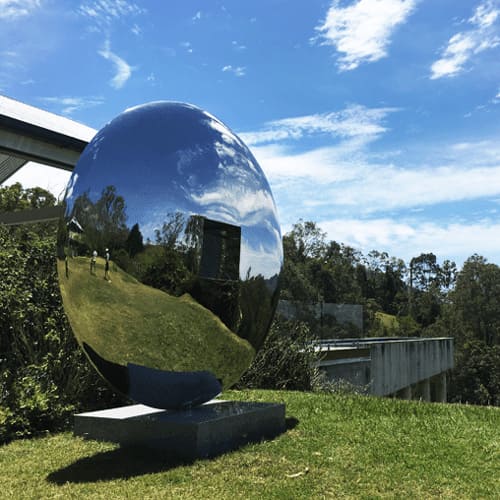
- Small to medium garden pieces
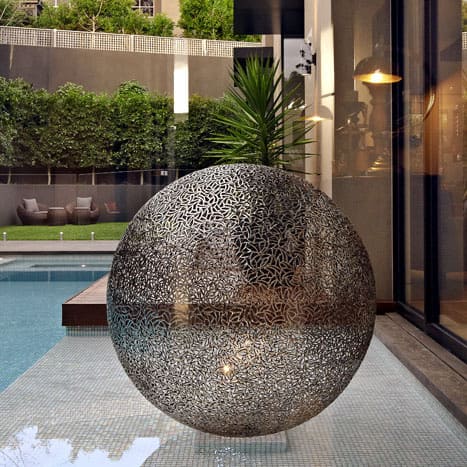
Ideal for courtyards, terraces and garden beds slightly back from the surf line. These might be mirror-polished or satin 316 works that create subtle reflections of planting and water without dominating the view. - Medium statement for poolside or rooftops
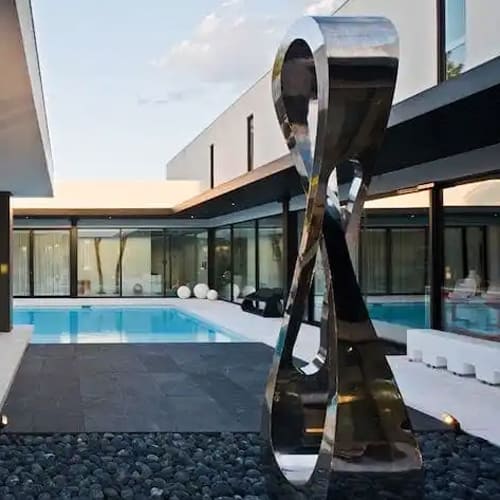
Think sculptural forms that rise from a plinth beside the pool, or anchor a rooftop terrace. Here we typically opt for 316 with mirror or electropolished surfaces, paired with careful siting to manage glare. - Large coastal landmarks
Works such as “Reflection” by Lachlan Ross– a powerful combination of stainless steel and corten – show how robust materials and refined detailing can live comfortably in exposed outdoor environments, from coastal boardwalks to elevated seaside gardens.
You can explore more examples in our
Next steps: de-risk your stainless specification
If you’re planning a sculpture for a coastal home, hotel pool or seaside rooftop and want it to stay beautiful long-term, we can help you work through:
- Grade selection (304 vs 316) for your specific site.
- Finish recommendations (mirror, satin, electropolish) matched to exposure and design intent.
- Placement and detailing to minimise tea staining and glare.
- A care plan suitable for your household staff or building management.
Speak with our team about your site, preferred style and budget.
Quick checklist for coastal & poolside stainless
Quick checklist
316 grade stainless? ✔
Finish chosen for environment (mirror / electropolish / satin)? ✔
Splash and overspray zone understood? ✔
Water traps and fixings detailed? ✔
Simple rinse & wash plan in place? ✔